Sunday, September 28, 2008

La Libertad

On Friday afternoon, Omar came into the office and said "Hannah, you know that we're leaving right?" I said, "Oh, no. Where are we going?" "We're going to lunch" he said. "Ok" I said as I grabbed my bag. We all got into the truck and headed off. We stopped to get gasoline and I asked Alba "Where are we going?" "To get lunch" she said. I realized that no one was going to tell me where we were going so I just enjoyed the ride (an hour or so) talking to Delmi and Ima.


Soon enough we arrived in a cute little town and the first thing that I see is THE OCEAN! I was so excited. We went into a little beach restaurant. It was great.


[Starting on the left: Alba, Ima, Claudia, Ruth, Omar, Maria Jose, & Delmi]

The girls and I walked out onto the beach (none of were quite dressed for the beach!) and enjoyed the sand and water. I love the beach! I love the waves and the sand! Ah, it was lovely! It made me really happy.


Maria Jose, Claudia, Ruth, & Delmi


Ruth and Maria Jose are the youngest at Cemujer. I love them. They're such fun to be around!

Friday, September 26, 2008

One week, it's good to be here

I've spent one full week at Cemujer. At times it feels like it's been longer and at times it feels like I just got here. I like being here. In some ways, it isn't at all what I expected and in other ways I don't think I had a very clear expectation of what it was going to be like. One thing I had no way to know about were the colors with which the house is painted.

I knew that it was know as the "Casa Morada" so, I expected the outside walls to be painted all purple (and maybe some of the interior ones too). Well, the house IS purple and the inside there is a purple room and as you walk further into the house the rest of the rooms are also very colorful. The ofice where I spend most of my time is painted a bright yellow and bright pink! The hallway is painted a bright orange with the oposite wall being a bright greet. And so on and so forth. Very, very colorful! Almost dizzying!

I hope to jump into a lot of the events that Cemujer is doing and do a lot more reading and writing, of course.

On a much more personal note, I'm moving again tomorrow. I realized that there IS a bus route that will take me to work and back from the Flores' house. I think it will be nice to stay with them, even though I really have no complaints with Fidelina.

I like being at work, I like El Salvador, but... I have to admit that a couple of the evenings this week when I got on the bus to go home I felt somewhat homesick (or lonely for my friends who are spread all over the place). It's not a plesant feeling but, it's also one that doesn't exactlly have a cure. I'm sure I wouldn't notice it as much if I had a lot of friends here, but the feeling remains even when you make new friends.

Tuesday, September 23, 2008

Impressions: war is that way

Neither side can claim innocence in the war. War is that way. Everyone is side is breaking the moral law ‘thou shalt not kill’ and no one can justify the violence that was committed. “We avoided choosing sides,” the woman told me “we tried to stay out of the conflict.” No one in her family was killed directly because of the war “we were taken care of, thank God.” She was a teacher during the war. “No one in my family was killed but one of my co-workers…” her voice trailed off.
“Maria Carmen” she went on, “was killed by some of her own students.” There was a moment of silence and the weight of that statement filled my heart and mind. “You see,” she said, “that was what it was like during those times. Everyone was filled with hatred and even your own students might turn on you to kill you.” She went on to say that that she felt like the hate persists today. “Both sides are ambitious for power,” and forgiveness is elusive.

Monday, September 22, 2008

Impressions: if we only used what we have

Carla* was in her twenties during the war. She worked as a housekeeper in San Salvador, regularly traveling about 40 miles from her hometown to the capital. Most of the fighting happened in different parts of the country, at yet the war touched everyone in some way. If it wasn’t someone you knew it was someone you worked with who was killed in the war.

On her rides on the bus she would talk to people and the things they would tell her were very interesting. Carla told me of a conversation she had with a man who lived in the mountains. “He said he was native of this land” she said, “but, no one is truly native anymore,” she added already questioning his right to complain.

She continued saying “He said that his land was stolen from him and that they were fighting for their land. I asked him how much land he owned and he said that he had ‘una manzana’. I asked him what he did with it and he said that he couldn’t do anything with so little land. He wanted the government to give him back his land and fix the road to their town.”

She looked doubtful as she said, “I asked him why he didn’t get together with the other people in his town to do something about the road. But, he didn’t want to --you see? He didn’t realize that they could have fixed the road and would have been able to improve their own situation without any help from the government. Instead, he was just complaining for a right I’m not sure was really his.”

On another bus ride Carla met another man with similar circumstances but a different attitude. She told me that he owned a small plot of land and he planted corn and other things on it. Then he was given three chicks that he raised into chickens they were all laying hens. He sold the eggs and saved enough money to buy a calf. He raised the calf and soon had another calf and a milk cow. His wife sold the milk and between all of those things on their small plot of land they found a way of living that was more comfortable than most. Carla said, “I think that most anyone can find a way if they set their mind to it and we don’t need the government to do everything for us.”

Carla said that she read the ‘communist’ literature and did not find it compelling, she was convinced that people should work hard and not expect the government to do everything for them. “That land” she said, “how could they prove that it should belong to them anyway?” It’s more complicated than that. The guerrilla didn’t convince her. “They said things that sounded good” she said with regret, “but, as they spoke about the land and the people they destroyed and stole people’s property. What kind of communism would that be?” Then with the brilliance of a storyteller she concluded, “If only everyone could be like the second man who used the little he had to get ahead.”

*I have not used her real name.

Sunday, September 21, 2008

it's almost Monday...

It’s not that there are days that I’m more predisposed to missing [certain friends, music, community, liturgy, vision, hugs, cities, food, parks, conversations, meals, early morning breakfasts, leisure activities, coffee shops, freedoms, assumptions] than others. It's just that...

..there are moments in almost every day of my life that I feel that sensation of “I wish ‘so and so’ were here” or “wouldn’t it be nice to hear her voice” or “he would love this right now” etc. I can never get used to it. I am always missing someone or someplace. Sigh. But, well, maybe Sundays are worse than other days. It might be strange but, I'm looking forward to Monday.

There are a few things I've learned about arriving in new places that are really important even though they are hard. 1. You need to be patient when developing friendships, the feeling of understanding and connectedness only comes in time. 2. It's important to listen (a lot) before voicing all your opinions, people don't have the same assumptions you do and it's important to understand theirs before you start voicing yours. 3. Remind yourself that you like to laugh more than you like to cry, even though there are things to be upset about there are plenty more to be quite happy about.

the mariachis, we and me


Last night, I saw some mariachis singing. Fun stuff.

Yesterday, I read the book "We are Smarter than Me" all about social networking how to use 'crowdsourcing' in business. Very interesting stuff. One thing that I noticed in the book was how important it was in many cases to still have a leader and someone guiding the conversation or direction of the business. The crowd all by itself is probably going to loose focus, but with the right leadership the crowd is capable of pretty amazing stuff. It's also amazing what people are willing to do for very little return other than a sense of belonging and importance.

Saturday, September 20, 2008

Rosita


I live with Rosita. I have to tell you that she's very sweet and servant hearted. When I was leaving this weekend she told me, "You need to know that we're going to miss you." She is 14 and should be in school but, her family is too poor to afford sending her to school. It breaks my heart. I wish I could make it better and help her be able to go to school.

understanding complexity

Talking about being 'nervous' with my brother, he told me that he felt the same way when he first arrived in Costa Rica. All the local people terrified him with their warnings and stories. The fact of the matter is that well, it's not like I've never traveled alone or like I'm not aware of my surroundings. I don't act very nervous, that's for sure, I have this unnerving composure. I'd been practicing my serious face for a while and I just hope that my eyes don't give away the fact that I'm smiling on the inside. Particularly because it's so funny for me to be so somber.

I have a hunch that I'm going to get a very interesting and diverse collection of impressions about El Salvador when this is all said and done. I am excited about that, I hope that I get to meet people from 'both sides'. I want to get to know some of the privileged and some of the poor. I hope to learn what makes them excited, what gives them hope, what motivates them, how they feel connected to humanity. I might also get a glimpse of the 'ugly' part of both sides, I wouldn't mind. I believe that we all have our terrible flaws and moments of weakness --none of us is perfect.

Impressions: things are better now

“During those days people didn’t leave their homes,” he talked freely without looking over his shoulder to see who might be listening, “but now, those times are past. New businesses are opening all the time and things are better.” He didn’t have to fight during the war even though he was almost recruited by the military, twice. “They would drive around the streets and if they saw young men walking around they would take you and if you didn’t have anyone call to claim you --you would have to fight.” The recruitment process basically involved kidnapping capable young men off the street and if no one you knew saw you, you would be forced to fight.

“With the military it was better, you see,” he said, “you would fight for two years and then they would let you go. With the guerrilla you couldn’t get away and their circumstances were much more rudimentary. They lived in the woods and didn’t always have adequate food or shelter.” He was always intrigued by the military and the study of the war. “It was the same here as in any war. Those who survived moved up in ranks as their friends were killed. There were very few heroics like those that are glamorized on TV. You couldn’t rescue your friends if they were shot, otherwise you would probably also loose your life.”

Then, as we talked about the peace that exists today he said, “No one can take the credit for the peace that we arrived at. It was a collective compromise that led to the ceasing of conflict.” He seemed to think that the international pressure was an important part in arriving at peace here. There were compromises and yet the government still remained in power and the same party is governing the country today. There is still an overt distrust between the two sides.

If you listen to the radio or watch television, the political advertisements warn against the left taking over and governing the country. One ad shows Hugo Chavez from Venezuela expressing his inflammatory opinions about America and then the slogan says “We don’t want Chavez to control El Salvador.” Implying, obviously, that if the opposition were to take power they will join the rest of the Latin American countries who are in solidarity with Chavez. It seems like there is very little alternative to the historical party divisions. (After I wrote this I saw the John McCain ads doing the same exact thing. I think they were doing it here first!)

Friday, September 19, 2008

Sinfonía!

The guest director was from Panama!


My new friends here in El Salvador.

Sarah and Christina!

Nervous

As I become more familiar with my surroundings you'd think that I'd feel less nervous as I go back and forth (maybe that will come). I think I feel a little more stressed now than I did a week ago. Everyone gives me warnings and more warnings about how dangerous it is here and how careful I need to be.

Wednesday, September 17, 2008

La Ruta de Las Flores!


The independence day parade in Concepción de Ataco.

The plaza.

The lovely traditionally painted wall!


Eating a choco-banana.


The loom.

A gorgeous garden at a restaurant (the food wasn't as great as the location).

sometimes it is enough to know that it is difficult

You can steel your heart against any kind of trouble, any kind of horror, but the simple act of kindness from a complete stranger will unstitch you. -Chris Abani (quoting his mother)

Tuesday, September 16, 2008

Technical dificulties...

For some reason I'm having a little trouble getting my pictures on here today. Yesterday was a super day. For independence day I went with Ricardo and Miriam on the Ruta de Las Flores. We saw a little parade and walked around a super cute town. I'll get the pictures on here as soon as I can.

Last night I moved so that I would be closer to the bus stop that will take me to work. For some reason that made me kind of sad. It's so bizzare, it's not like I'm leaving the country already or anything. What am I going to do when it's time for me to leave! Well, it's good to have external things remind you that you actually are connected emotionaly to the people and places around you.

Tomorrow, I go to Cemujer to meet everyone there.

Sunday, September 14, 2008

From the Volcano

We drove up to the volcano today. It is beautiful up there.


A little to bright...


Israel and I

El Salvador will be the tomb where the reds will end up

Today, for the first time, I heard the anthem of the leading political party ARENA.
I will give you a very rough translation of it:

Nationalist Republican Alliance of El Salvador
Present, present for the fatherland (patria/country)
Liberty is written with blood, work, and with sweat
Let us join together sweat and blood, but first EL Salvador//

When in the beloved fatherland strange voices were heard
The nationalists rose up saying this:
Yes to the fatherland, No to communism (patria si, comunismo no)
Yes to the fatherland, No to communism

Liberty is written with blood, work, and with sweat
Let us join sweat and blood, but first EL Salvador//

El Salvador is the tomb where the reds will end-up…
In this way saving America, our immortal America

I am particularly struck by the line that says: "El Salvador is the tomb where the reds will end." I am by no means a communist but, the violence of that symbolism strikes me. It's unbelievable and I would want to think that this anthem is sorely out of date. I certainly don't know. I'm curious to find out what the FMLN anthem sounds like.

Saturday, September 13, 2008

Locura general

Well, it seems like the region is in an interesting state of 'reaction-ism'. Bolivia's president just expelled the US Ambassador and Venezuela's Chavez followed asking the Ambassador to immediately leave the country. Then, to top it off the president of Honduras said that it would post-pone the reception of the new American Ambassador that was schedule to arrive soon. Interesting stuff.

Marimbas


Last night we went to the movies at a very nice shopping center here in San Salvador and there were some men playing the Marimba! It was so nice. I would like to put the video of it up but, I haven't figured out how to do that yet.

Friday, September 12, 2008

Mi Familia: los Flores

Here I am with my new parents here in El Salvador. Miriam and Ricardo.
Israel isn't in the picture because he's the one taking it.

El Salvador : A short history

(This is a simple time line with some important dates and names in modern Salvadoran history.)

1929 –El Salvador suffered an economic crisis involving the fall of coffee prices, and significant increase in levels of unemployment.
1932 (La Matanza) – there was an agrarian and peasant uprising led by the communist leader of the Communist Party of El Salvador Faribundo Marti to which the military responded with force and in a matter of a few weeks 15,000-30,000 people were killed by the military of Maximiliano Hernández Martínez’s government and started the period of military dictatorship in El Salvador that lasted until 1979.

1969 (La Guerra de Futbol) – the ‘Soccer War’ (or the 100 Hour War) broke out during a World Cup Soccer qualifying match between El Salvador and Honduras. The conflict was provoked by border disputes and the instability of relations between the countries due to the masses of Salvadorans who had crossed over to Honduras during the '60's looking for work and economic stability.

1972 –the military arrested the president and death squads were established throughout the country.
1979 -the president was overthrown (after several internal military coups).
1980 – In March, Napoleon Duarte takes charge of the country and begins to implement US supported political reforms and declared that the country was in a state of war.

In March, the Salvadoran Communist Party creates the FAL (Fuerzas Armadas de Libracion/ the Armed Forces of Liberation)and on March 24th Oscar Romero the Roman Catholic bishop (who was outspoken against the support being given to the military by the US) was assassinated by the group said to have been led by General Roberto D'Aubuisson.

In October, all the opposition groups join together and become the FMLN (Frente Faribundo Marti para la Liberacion Nacional) – the organization that took the name of Faribundo Marti (who was arrested and killed after the peasant uprising in 1932) and became the guerrilla during the war and is the current opposition party in El Salvador.

1981 – In January General D’Aubuisson was arrested with the accusation of trying to overthrow Duarte. In September it was reported that 32,000 civilians had been killed by government forces or death squads linked to the Military. D’Aubuisson started the Nationalist Republican Aliance party (ARENA).

In December from the 10th-13th the Salvadoran Armed Forces were involved in the incident that is known as El Mozote Massacre which occurred in the department of Morazan. It is e estimated that up to a 1,000 people were killed and many more fled to Honduras.
The FMLN guerrilla also was involved in violent acts against government and business leaders and destroyed public infrastructure, and other significant violent crimes against society.

1989 – Alfred Cristiani of ARENA became president by popular vote. In April, the FMLN presents its proposal for a peace agreement.
The US funneled 6 billion dollars to the government during the 12 years of civil war. During those years 300,000 people fled the country, 75,000 people were killed, and approximately 9,000 disappeared.

1992 –a peace agreement was signed and ARENA remained in power with the FMLN as the main opposition party
In 1994 and 2004 the ARENA candidates won the presidency with Elías Antonio Saca as the current president.

El Salvador still lives with the significant differences only resting slightly under the surface of the national conversation. After the peace agreements were signed the National Assembly extended amnesty to those who would have been guilty of war crimes.

Post-war El Salvador found itself with a level of violence perpetuated by ‘Maras’ or gangs which are said to have originated from the Salvadorans who were deported from the US. The level of crime became so paralyzing that the president established the plan ‘Mando Dura’ (the Hard Hand) to fight gang crime.

One of the largest sources of income in El Salvador comes from the estimated $2,000 in remittances that are sent back to the country from the Salvadorans who live outside of the country. There are approximately 2 million expatriate Salvadorans. This is the source of many conversations about the stability of the Salvadoran economy and its future self-sufficiency as a nation.

Wednesday, September 10, 2008

Now... for the important stuff


Now... for the important stuff. (This is for Erin, who I know will be following soccer more faithfully than most!) The World Cup playoffs! El Salvador is still a hopeful for the World Cup and today as I was walking around a mall I saw a crowd of people standing outside a store.

It had a TV in the window that was broadcasting the World Cup elimination game between Suriname and El Salvador. (El Salvador won 2-0.) It's a big deal! (To make it more interesting, I've met the sister of one of the players on the El Salvador national team.) So, if I make it to a game I'll let you know how it is!

Mansion in the Mall


Here's something you probably haven't ever seen before. There is a shopping mall here in San Salvador that was built around a mansion. The house was so big and pretty (I guess) they decided that instead of taking it down they'd just build up around it. You can kind of get the idea of it in this picture.

Wine a la . . .


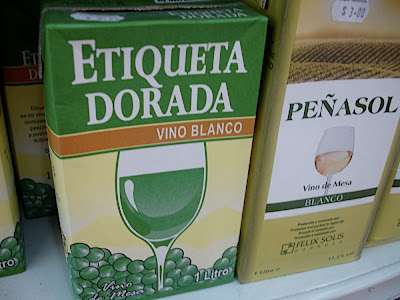
So, for all my friends who are wine drinkers. I've found something special for you. Wine in a carton. (Eww.) Anyway, I thought you might like that.
Tuesday, September 9, 2008

The volcano


This is the view out of the back porch from the place where I'm staying this week. That is a volcano that is right next to San Salvador. I am still finding my way around the city and deciding life here.

Monday, September 8, 2008

I've arrived in San Salvador


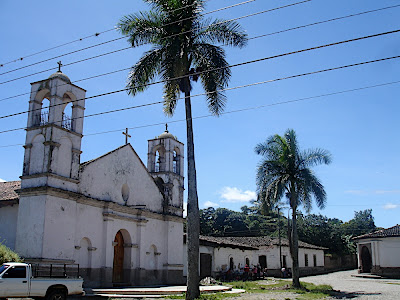
On Saturday my parents and I drove to Cucuyagua, Copán and visited some friends of theirs there. We also stopped in Corquin where I took all of these pictures. We were going to stay in Cuguyagua but, they hadn't had water for four days and we decided it would be easier for everyone if we just went ahead! Four days without water!

Anyway, we went on to Ocotopeque which is close to the border with El Salvador. On Sunday we went to church with other friends there and they took care of us. This morning I got to take a famous bucket bath because they didn't have any running water this morning. We spent the night and this morning another friend who lives in Honduras but is from San Salvador met us to guide us into the city. It was very kind of him because we had no idea what we were doing.

It was only about a two hour drive to San Salvador where we met with another friend who had been recommended to us. We were very well cared for. He showed us around. Took me to see where I'd be working, took me to see his mother's home where I might decided to live these three months, and helped me get a cell phone.

Now, I'm going to stay this week with our friends from Venezuela and I'm feeling very happy with all of these kind people. Tomorrow, hopefully we'll meet some other of our contacts and by the end of the week I'll probably be settled here. Right now I'm a bit exhausted because I haven't gotten much sleep for a week or so but, it's fun to be back in Central America.

Corquin, Copán


Santa Rosa de Copan


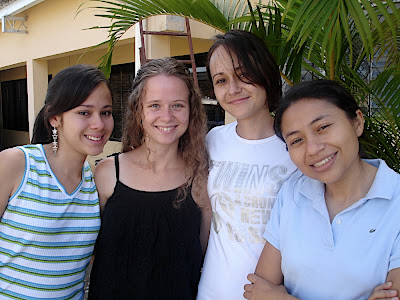
Eunice, Hannah, Carlita, and Eunice

Orlando & Teresita and Nancy & John

On Friday we drove to Santa Rosa de Copan where we spent the night with the Aritas. I cannot tell you what kind and generous people they are. Orlando has a coffee plantation where he grows and toasts his own coffee. He drinks more coffee than anyone I know! I enjoyed an evening of great fun (and little sleep, as always) with the two Eunices and Carlita.

Friday, September 5, 2008

Santa Barbara


This is the view from Santa Barbara, the city where my parents live.

Las Rosas, Honduras


This is up in Las Rosas at where my dad is doing a lot of tree planting.
It is so beautiful up there.
live the questions now... R.M. Rilke